
Stop Hiring More SOC Analysts. Start Hiring AI Agents
28 Jul 2026 · by Faiq · 4 min read
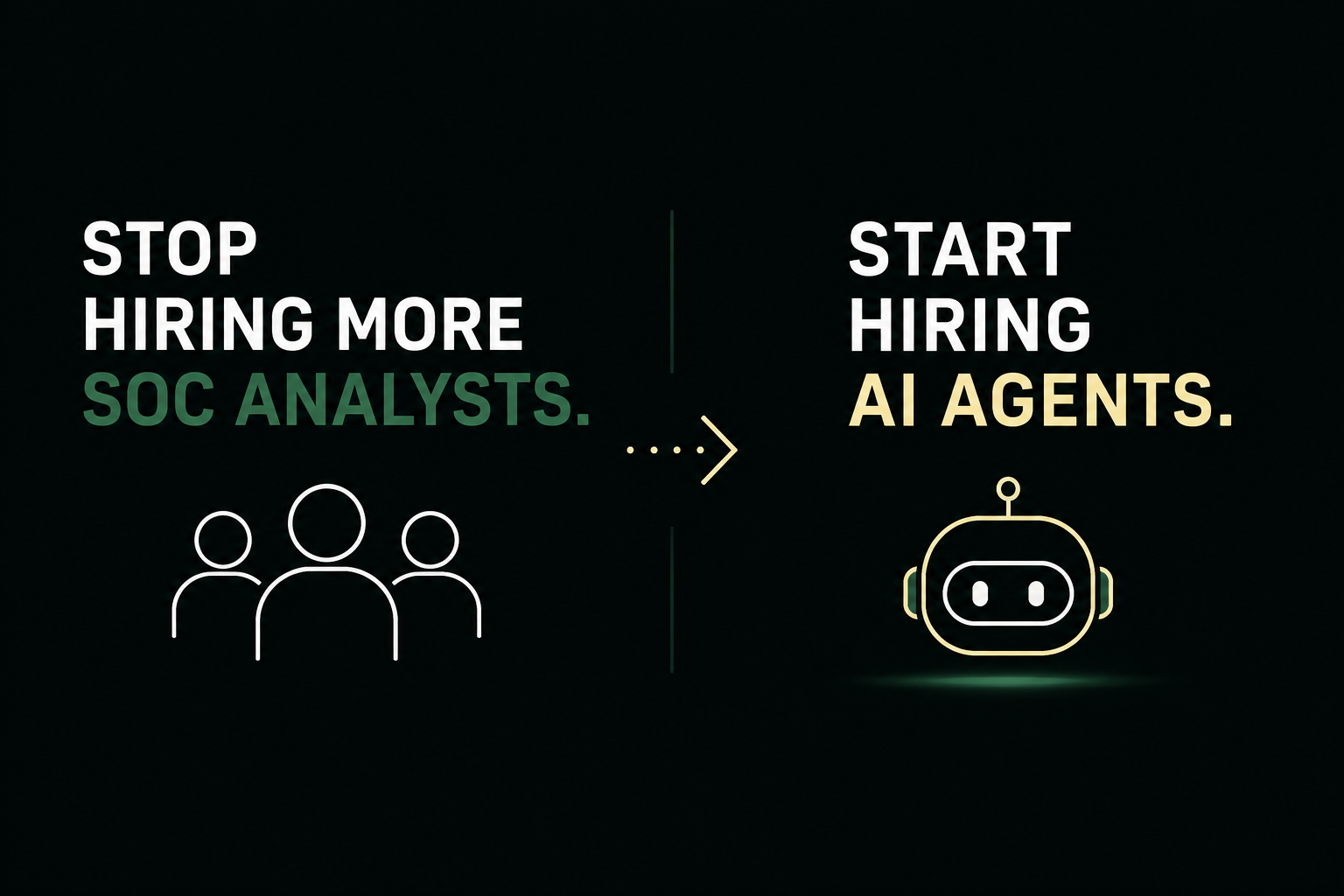
Stop Hiring More SOC Analysts. Start Hiring AI Agents.
Key Highlights (TL;DR)
- Cyber threats are increasing faster than organisations can hire security analysts.
- Modern Security Operations Centres (SOCs) are overwhelmed by alert fatigue and repetitive investigations.
- AI Agents can autonomously investigate, correlate and prioritise alerts within seconds.
- Human analysts remain essential for strategic decisions, incident leadership and complex threat hunting.
- The future of cybersecurity belongs to organisations that combine AI Agents with human expertise.
Hiring more SOC analysts used to be the obvious answer whenever security teams became overwhelmed.
Today, that strategy is becoming increasingly expensive, increasingly difficult and increasingly ineffective.
The cybersecurity industry is facing a global shortage of skilled professionals while attackers continue to automate almost every stage of their operations. Phishing campaigns are generated by AI. Malware evolves automatically. Credential attacks run continuously around the clock.
Meanwhile, many organisations are still expecting human analysts to manually investigate every single security alert.
That operating model no longer scales.
The Real Problem Isn't Too Few Analysts
Every SOC manager has experienced the same challenge.
- Thousands of alerts every day.
- False positives consuming valuable time.
- Multiple security tools generating duplicate incidents.
- Analysts repeatedly performing the same investigation steps.
- Growing burnout across security teams.
When organisations experience alert overload, the traditional response is simple: hire another analyst.
But adding more people does not eliminate repetitive work. It simply distributes the workload across a larger team while operational costs continue to rise.
Attackers Already Use Automation. Why Don't Defenders?
Cybercriminals do not manually inspect every victim before launching an attack.
They automate reconnaissance, phishing campaigns, vulnerability scanning, credential stuffing and malware deployment.
Defenders, however, often continue relying on analysts to perform repetitive investigations that follow nearly identical workflows every day.
If attackers can automate offensive operations, defenders should automate defensive operations.
This Is Where AI Agents Change Everything
Unlike traditional automation or simple AI chatbots, AI Agents are designed to achieve objectives rather than execute a single predefined task.
Instead of waiting for instructions, an AI Agent can independently gather evidence, analyse multiple data sources and recommend the next course of action.
| Traditional SOC | Agentic SOC |
|---|---|
| Analysts manually review alerts | AI Agents investigate alerts automatically |
| Evidence collected manually | Evidence gathered across multiple systems within seconds |
| Manual threat correlation | Automatic cross-platform correlation |
| Analysts spend hours on repetitive work | Analysts focus on high-value investigations |
| Slower incident response | Rapid prioritisation and response recommendations |
Imagine an AI Agent Investigating an Alert
Instead of assigning an analyst to investigate a suspicious login, an AI Agent immediately begins working.
- Reviews identity logs.
- Analyses endpoint activity.
- Checks email history.
- Queries threat intelligence.
- Correlates firewall events.
- Identifies affected users.
- Calculates business impact.
- Produces an investigation summary.
- Recommends containment actions.
By the time a human analyst opens the incident, the investigation is already completed.
The analyst no longer spends thirty minutes collecting evidence. Instead, they spend their time making informed security decisions.
Will AI Replace SOC Analysts?
No.
It will replace repetitive work.
Cybersecurity still requires human judgement, business understanding and strategic decision-making.
Experienced analysts remain essential for advanced threat hunting, digital forensics, executive communication and incident leadership.
However, spending hours enriching alerts, searching logs and documenting incidents is no longer the best use of highly skilled professionals.
AI Agents should perform repetitive investigations while analysts focus on defending the organisation.
The Future SOC Looks Different
Tomorrow's SOC will not simply have more dashboards.
It will have teams of specialised AI Agents.
- Alert Investigation Agent
- Threat Intelligence Agent
- Identity Security Agent
- Cloud Security Agent
- Incident Response Agent
- Executive Reporting Agent
Human analysts will coordinate, validate and make strategic decisions while AI Agents perform the repetitive operational work twenty-four hours a day.
The Organisations That Adapt First Will Win
The cybersecurity industry has always evolved alongside technology.
Firewalls replaced manual network filtering.
EDR replaced traditional antivirus.
Cloud-native security replaced perimeter-only defence.
The next evolution is Agentic Security Operations.
Organisations that continue relying solely on growing analyst headcount will struggle with rising costs and increasing alert volumes.
Those that embrace AI Agents will investigate faster, respond sooner and allow their security professionals to focus on what humans do best.
HyperDEF's Vision
At HyperDEF, we believe the future of cybersecurity is not about replacing people. It is about giving every security team intelligent AI teammates capable of investigating alerts, correlating evidence, explaining incidents in plain English and accelerating response around the clock.
The future SOC is not defined by how many analysts you hire.
It is defined by how intelligently humans and AI Agents work together.
Related Articles
How secure is your business right now?
Find out in 10 minutes. Our free Cybersecurity Health Check gives you a clear, plain-English risk score with AI-powered insights: no jargon, no obligation.