
Why ISO 27001 Certification Fails Without Continuous Security Monitoring
29 Jul 2026 · by Faiq · 4 min read
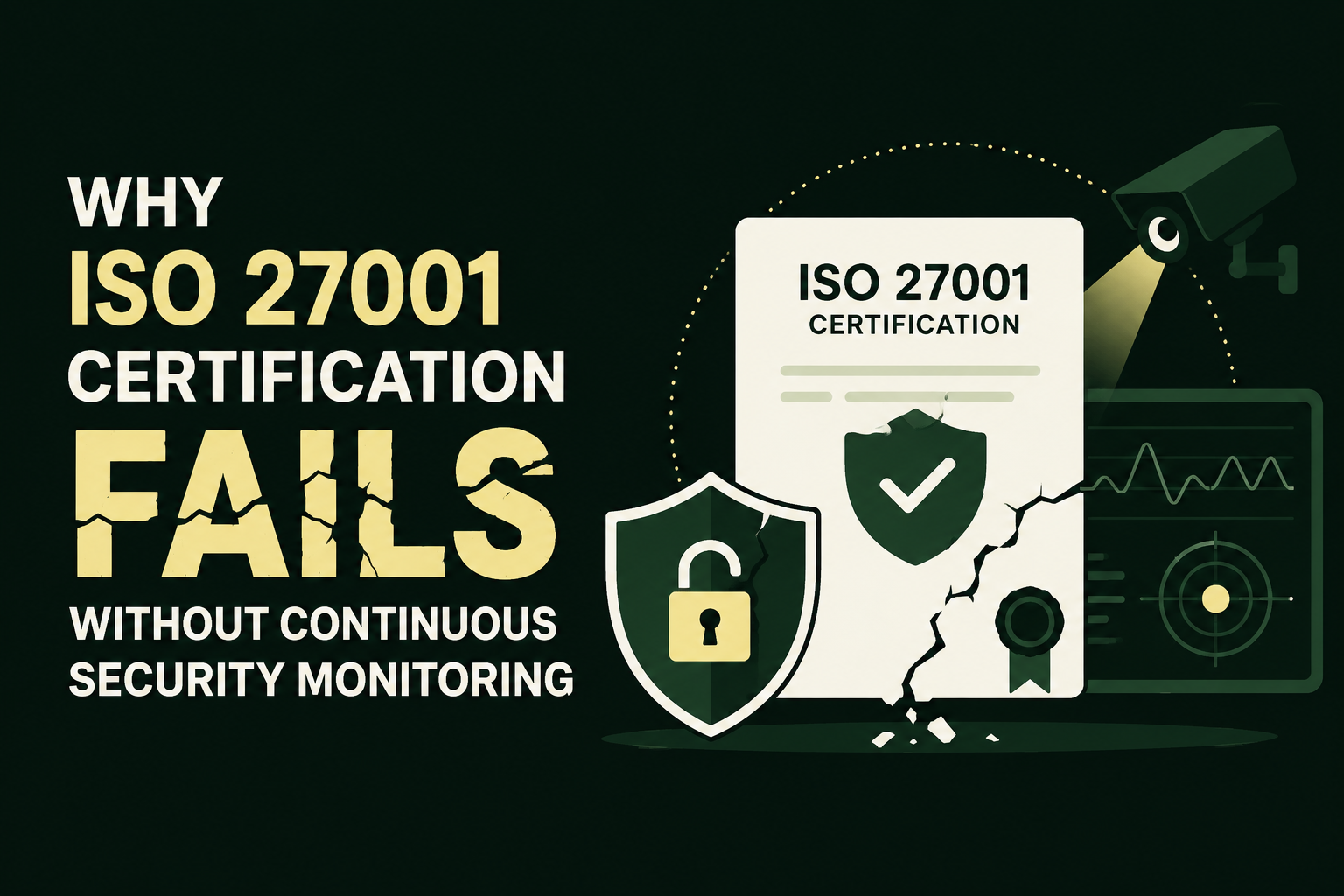
Why ISO 27001 Certification Fails Without Continuous Security Monitoring
Key Highlights (TL;DR)
- ISO/IEC 27001 is an international standard for establishing, implementing, maintaining and continually improving an Information Security Management System (ISMS).
- ISO 27001 certification demonstrates that an organisation's ISMS conforms to the standard's requirements, but it does not guarantee protection from cyberattacks.
- Cyber threats continuously evolve, making ongoing monitoring and risk management essential.
- Continuous security monitoring helps organisations detect suspicious activity, evaluate the effectiveness of security controls and respond to incidents more quickly.
- Combining ISO 27001 with continuous security monitoring creates a stronger and more resilient cybersecurity programme.
Achieving ISO/IEC 27001 certification is an important milestone for any organisation.
It demonstrates that the organisation has implemented an Information Security Management System (ISMS) based on internationally recognised best practices for managing information security risks.
Many customers, business partners and regulators view ISO 27001 certification as evidence of a mature security programme.
However, one common misconception remains.
ISO 27001 certification does not mean an organisation cannot be breached.
Cyber threats continue to evolve every day, and maintaining security requires continuous operational visibility long after the certification audit has been completed.
What ISO 27001 Actually Certifies
ISO/IEC 27001 is a management system standard, not a guarantee that every cyber threat has been eliminated.
Certification demonstrates that an organisation has established, implemented, maintained and continually improved an Information Security Management System in accordance with the requirements of ISO/IEC 27001.
The standard focuses on governance, risk management, documented processes, internal audits, management reviews and continual improvement rather than certifying that an organisation is immune to cyberattacks.
Cyber Threats Do Not Stop After Certification
The cybersecurity landscape changes continuously.
New software vulnerabilities are disclosed regularly, phishing campaigns constantly evolve, attackers adopt new techniques and organisations frequently introduce new systems and cloud services.
A security control that was appropriate during certification may require adjustment as business operations and cyber risks change.
For this reason, ISO 27001 promotes continual improvement of the ISMS rather than treating certification as the end of the security journey.
Why Continuous Security Monitoring Matters
Continuous security monitoring provides ongoing visibility into an organisation's security environment.
By collecting and analysing security events from endpoints, identities, cloud platforms, servers and networks, organisations can identify suspicious activity and respond more quickly when security incidents occur.
Continuous monitoring also helps organisations evaluate whether security controls continue to operate effectively as their environment evolves.
| ISO 27001 Objective | How Continuous Monitoring Supports It |
|---|---|
| Risk Management | Provides visibility into emerging threats that may require updated risk assessments. |
| Incident Management | Helps detect and investigate potential security incidents more quickly. |
| Performance Evaluation | Provides operational evidence to help assess whether security controls remain effective. |
| Continual Improvement | Supports ongoing improvements based on operational findings and changing risks. |
Certification Is Periodic. Threats Are Continuous.
Certification audits occur at scheduled intervals.
Cybercriminals do not operate according to audit schedules.
Attackers continuously search for vulnerable systems, compromised credentials and exposed services regardless of when an organisation was certified.
Continuous security monitoring helps organisations maintain awareness between audits by identifying unusual behaviour that may require investigation.
ISO 27001 Is One Part of a Strong Security Programme
ISO 27001 provides an excellent framework for managing information security, but governance alone is not sufficient to defend against modern cyber threats.
Most organisations complement their ISMS with operational security capabilities such as endpoint protection, vulnerability management, identity security, employee awareness training, secure backups, incident response planning and continuous security monitoring.
Together, these capabilities help organisations manage risks while supporting the continual improvement principles defined by ISO/IEC 27001.
Continuous Monitoring Strengthens Compliance
Continuous monitoring should not be viewed as a replacement for ISO 27001.
Instead, it strengthens an organisation's ability to operate its Information Security Management System effectively by providing timely visibility into security events and supporting informed risk management decisions.
Organisations that continuously monitor their environments are generally better positioned to detect security incidents, evaluate control effectiveness and respond to evolving threats.
Final Thoughts
ISO/IEC 27001 certification is an important achievement that demonstrates an organisation's commitment to information security management.
However, certification alone does not prevent cyberattacks.
Maintaining security requires continual risk assessment, ongoing operational vigilance and the ability to detect and respond to threats as they emerge.
By combining ISO 27001 with continuous security monitoring, organisations can strengthen their overall cybersecurity posture while supporting the continual improvement objectives of their Information Security Management System.
How HyperDEF Can Help
At HyperDEF, we believe compliance should be the foundation of cybersecurity, not the finish line.
Our Cybersecurity Health Check helps organisations identify security gaps, while our Managed Detection & Response (MDR) service provides continuous monitoring to improve threat detection and support faster incident response.
Compliance demonstrates your commitment to security. Continuous monitoring helps you maintain it.
Related Articles
How secure is your business right now?
Find out in 10 minutes. Our free Cybersecurity Health Check gives you a clear, plain-English risk score with AI-powered insights: no jargon, no obligation.